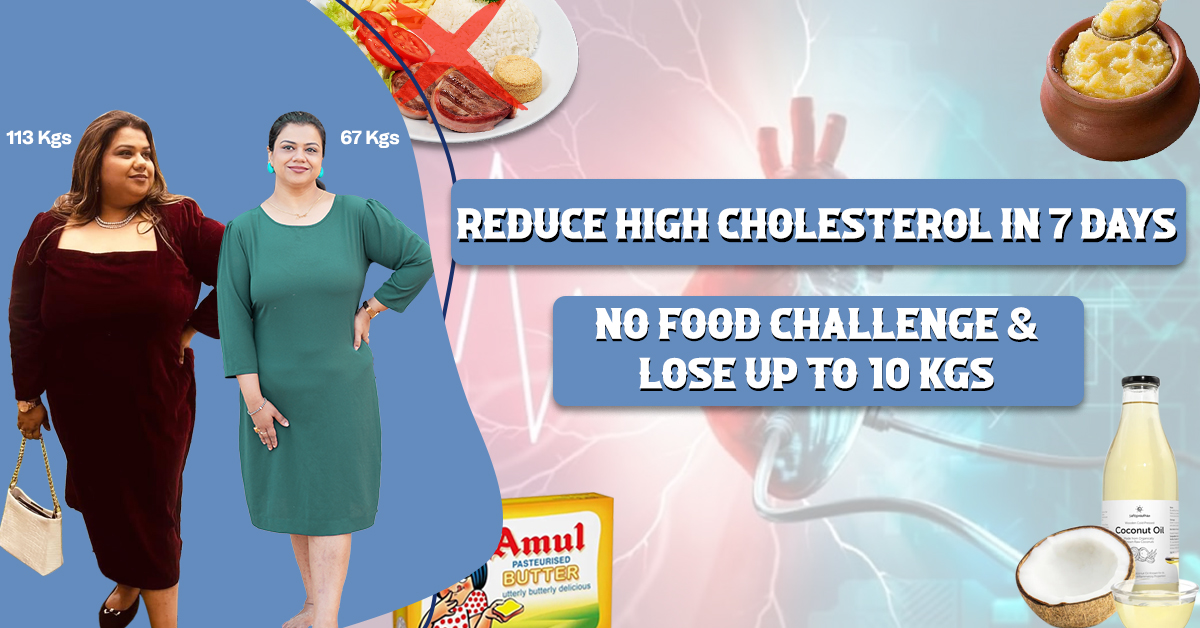
Reduce High Cholesterol in 7 Days No Food Challenge & Lose Up to 10 Kgs
High cholesterol is one of those health problems that usually does not announce itself loudly. You go for a routine blood test, and the report comes back with numbers that concern your doctor. You may feel completely normal – but elevated LDL and triglycerides are already at work.
For many Indians, this is confusing. You eat home-cooked food. You do not eat fast food every day. So why is cholesterol high? The answer often surprises people: high cholesterol in Indians is frequently driven not by obvious junk food, but by daily patterns – excess refined carbohydrates, inadequate protein, hidden sugars, too little fibre, and the cumulative effect of cooking oil across three meals a day.
The good news is that diet can make a real, measurable difference – especially for LDL and triglycerides – without exotic ingredients or starvation. This guide shows you exactly what to eat, what to avoid, and what a practical 7-day Indian plan looks like.
What Your Cholesterol Report Actually Means
Before changing your diet, understand which number to focus on. Not all cholesterol is equally concerning:
| Marker | What it is | Normal Range (approx.) | Concern Level | Diet Helps? |
| LDL (‘bad’) | Contributes to plaque in arteries | <100 optimal / <130 acceptable | 130+ mg/dL | ✓ Yes – fibre, less saturated fat |
| HDL (‘good’) | Removes excess cholesterol from blood | >60 mg/dL | <40 mg/dL | ✓ Yes – exercise, healthy fats |
| Triglycerides | Blood fat linked to sugar & refined carbs | <150 mg/dL | 200+ mg/dL | ✓✓ Most diet-responsive |
| Total Cholesterol | Overall reading | <200 mg/dL desirable | 240+ mg/dL | ✓ Partially |
| ✅ Key Point for Reader
Triglycerides are the most diet-responsive marker. Significant improvement is often visible in 4–8 weeks of cutting sugar and refined carbs. All values above are approximate – always check your doctor’s personalised targets for your age and health history. |
||||
Why Indians Develop High Cholesterol
| Common Indian Habit | Why It Raises Cholesterol |
| Chai with biscuits or rusk twice a day | Refined flour + trans fat + sugar – raises LDL and triglycerides quietly |
| Large rice or roti portions with thin dal | High carb, low protein, low fibre → raises triglycerides |
| Weekend restaurant meals: biryani, chole bhature, dessert | Weekly average becomes high even when weekdays are controlled |
| Excess ghee, butter, cream, malai across all meals | Saturated fat raises LDL when consumed in large amounts throughout the day |
| Sweetened drinks, fruit juice, sweet lassi daily | Liquid sugar rapidly raises triglycerides |
| Sedentary lifestyle – desk work, no walking | Low physical activity lowers HDL (‘good’ cholesterol) |
| Chronic stress and poor sleep | Raises cortisol → increases belly fat → worsens all cholesterol markers |
Best Indian Foods to Reduce Cholesterol
| Food | Why it helps | How to use it | Status |
| Oats | Soluble fibre (beta-glucan) reduces LDL absorption in the gut | Vegetable oats upma, oats chilla, oats with curd and chia seeds | Eat freely |
| Dal & legumes (moong, masoor, chana, rajma) | Plant protein + soluble fibre → improves LDL and satiety | Make dal thicker; eat before roti or rice | Eat freely |
| Garlic | Allicin compound has shown LDL-reducing effects in research | 1 raw clove on empty stomach; or 2–3 cloves in cooking daily | Eat freely |
| Isabgol (psyllium husk) | Soluble fibre binds cholesterol in gut, reducing absorption – strong evidence | 1 tsp in water 20 minutes before meals | Eat freely |
| Walnuts & flaxseeds | Omega-3 fatty acids raise HDL and lower triglycerides | Small handful of walnuts; ground flax in curd or dal | Portion control |
| Curd (plain, unsweetened) | Probiotic bacteria improve gut health and lipid metabolism | With every main meal; plain chaas as evening snack | Eat freely |
| Vegetables (bhindi, spinach, beans, brinjal) | Fibre, low calorie, fill the plate – reduces total calorie and fat load | Half the plate at every meal | Eat freely |
| Fish (non-vegetarians) | Omega-3 directly lowers triglycerides and raises HDL | Grilled or steamed 2–3 times per week; not deep fried | Eat freely |
| Green tea | Catechins reduce LDL oxidation and support fat metabolism | 1–2 cups daily without sugar or milk | Eat freely |
| Millets (bajra, jowar, ragi) | More fibre and protein than wheat; lower GI than white rice | Use as roti or khichdi instead of maida-based foods | Eat freely |
Foods to Avoid or Reduce
| Food / Category | Why it worsens cholesterol | Better swap | Status |
| Biscuits, rusk, khari, bakery items | Refined flour + trans fat → raises LDL quietly across the day | Roasted chana, makhana, fruit | Avoid daily |
| Sweets, mithai, halwa, kheer | High sugar → raises triglycerides directly | Occasional only; fruit daily instead | Occasional only |
| Sweetened drinks, cold drinks, fruit juice | Liquid sugar raises triglycerides rapidly | Chaas, nimbu pani unsweetened, green tea | Avoid daily |
| Excess ghee, butter, cream across all meals | Saturated fat raises LDL in large cumulative amounts | 1 tsp ghee for flavour only | Limit sharply |
| Maida-based foods (naan, bhatura, white bread) | High GI, no fibre → spikes blood sugar and triglycerides | Phulka, millet roti, jowar roti | Limit sharply |
| Creamy restaurant gravies (dal makhani, butter paneer) | Heavy cream + butter = high saturated fat in one meal | Tandoori, tomato-based options when eating out | Occasional only |
| Fried snacks (samosa, pakora, chips) | High saturated fat + refined carbs + low nutrition | Sprouts chaat, roasted chana, buttermilk | Avoid daily |
Want a Personalised Plan for Your Cholesterol? Copy: Our structured programmes include condition-specific guidance for high cholesterol, fatty liver, and prediabetes – using everyday Indian food. Button 1: Explore Fitness Plans
7-Day Indian Meal Plan for Cholesterol Reduction
This plan is built around three principles: high fibre at every meal, a named protein source at every meal, and controlled saturated fat. It looks like normal Indian food – because it is. The difference is in portions and choices within each category.
| Day | Breakfast | Lunch | Eve. Snack | Dinner |
| Mon | Veg oats upma + curd | 2 phulkas + bhindi + thick dal + salad | Roasted chana (30g) + green tea | Moong dal chilla (2) + cucumber raita |
| Tue | Moong dal chilla (2) + mint chutney | Rajma (½ katori) + small rice + salad + curd | 1 guava or apple | Dal soup + sautéed vegetables + 1 phulka |
| Wed | Idli (2) + sambar + green chutney | Chana sabzi + roti + lauki sabzi + curd | Makhana (roasted, no oil) | Tofu or paneer bhurji + 1 roti + salad |
| Thu | Greek yogurt + chia seeds + papaya | Lobia or mixed dal + sabzi + roti + salad | Plain chaas (buttermilk) | Khichdi (extra dal) + curd + lauki sabzi |
| Fri | Besan chilla (2) + curd | Moong dal + mixed veg + 2 phulkas + salad | Pear or orange | Sambar + 2 idli + green chutney |
| Sat | Dalia (broken wheat) with vegetables + curd | Rajma + salad + curd (no rice today) | Roasted chana + 5 walnuts | Veg soup + grilled paneer or tofu |
| Sun | Moong dal dosa + sambar | Family meal – more dal/sabzi, less rice; add salad | Fruit | Light – dal khichdi or chilla + curd |
| ✅ The One Daily Change That Makes the Most Difference
Replace tea-time biscuits and namkeen with roasted chana, makhana, or plain chaas. This single swap removes trans fat, refined flour, and 40–80 empty calories per snack – while adding protein and fibre. Done consistently for 4–6 weeks, it measurably improves triglycerides without changing anything else. |
||||
Home Remedies for High Cholesterol – What Actually Helps
| Remedy | What the evidence says | How to use it |
| Garlic | Allicin in garlic has shown modest but consistent LDL-reducing effects in research | 1 raw clove on empty stomach in the morning; or 2–3 cloves in tadka daily |
| Isabgol (psyllium husk) | Strong evidence – soluble fibre binds bile acids in the gut, reducing LDL absorption. One of the most effective dietary interventions. | 1 tsp in a full glass of water 20 minutes before meals. Drink plenty of water. |
| Methi seeds (fenugreek) | Soluble fibre content – modest cholesterol benefit. Also helps blood sugar. | Soak 1 tsp overnight; drink the water in the morning |
| Coriander seeds water | Traditional remedy – limited formal research. May support digestion and mild lipid improvement. | Boil 1 tsp in water, strain and drink once daily |
| Yoga and walking | Regular physical activity is one of the most consistent interventions for raising HDL. Walking 30 minutes daily has measurable lipid benefits. | 20–30 minutes brisk walking daily; yoga for stress reduction which also helps |
About the 7-Day Fasting Challenge
IWLD also offers a structured 7-day fasting course for people who want to use supervised fasting as a method to reset their metabolism and reduce cholesterol rapidly. This involves consuming only water, lemon water, black coffee, and green tea under expert guidance for 7 days.
Water fasting, when done under proper supervision, can produce significant short-term improvements in LDL, triglycerides, and weight. However, it is not suitable for everyone and requires daily live Zoom guidance from an IWLD teacher to do safely. The maintenance phase after fasting is what determines whether the results last.
The supervised 7 Days No Food Challenge is available at ₹2,499 (Zoom only) or ₹4,499 (with personal teacher). It is not recommended to attempt extended fasting without expert guidance.
Exercise, Sleep & Stress – The Non-Food Factors
| Habit | Effect on cholesterol | Where to start |
| Daily walking | Raises HDL, reduces triglycerides, supports weight and belly fat reduction | 20–30 minutes daily; brisk pace; after meals is ideal |
| Strength training | Preserves muscle during fat loss; improves insulin sensitivity; raises HDL | 2–3 times per week – squats, resistance bands, bodyweight exercises |
| 7–8 hours sleep | Poor sleep raises cortisol → increases belly fat → worsens all lipid markers | Consistent sleep and wake time; no screens after 10 PM |
| Stress reduction | Chronic stress raises cortisol which promotes belly fat and worsens LDL/HDL ratio | 10-minute walk after meals; breathing exercises; reduce emotional eating triggers |
Frequently Asked Questions
Q: What are the symptoms of high cholesterol?
A: High cholesterol typically has no symptoms – this is why it is called a ‘silent’ condition. Most people discover it only through a blood test. In some rare cases, very high cholesterol over many years can lead to xanthomas (fatty deposits under the skin) or xanthelasmas (around the eyes). The only reliable way to know your cholesterol levels is a lipid profile blood test.
Q: What is a normal cholesterol level?
A: As a general guide: Total cholesterol below 200 mg/dL is desirable; 200–239 mg/dL is borderline high; 240+ mg/dL is high. LDL below 100 mg/dL is optimal; below 130 mg/dL is acceptable; 160+ mg/dL is concerning. HDL above 60 mg/dL is protective; below 40 mg/dL (men) or 50 mg/dL (women) is low. Triglycerides below 150 mg/dL is normal; 200+ mg/dL is high. Always check your doctor’s personalised targets.
Q: Is ghee bad for high cholesterol?
A: Ghee in very small amounts (one teaspoon for flavour) is unlikely to significantly worsen cholesterol on its own. The problem is when ghee is added to roti, dal, rice, khichdi, and paratha – all in the same day. The cumulative saturated fat load becomes high. If your LDL is elevated, use ghee sparingly for flavour in one meal only, not across all meals.
Q: Is curd good for cholesterol?
A: Yes – plain, unsweetened curd (dahi) is beneficial for cholesterol. The probiotic bacteria in curd help improve gut health, which has a downstream effect on lipid metabolism. Use full-fat curd in moderation or low-fat curd freely – avoid flavoured or sweetened yogurt, which adds sugar. Chaas (buttermilk) is an excellent daily drink for people with high triglycerides.
Q: Does isabgol reduce cholesterol?
A: Yes – isabgol (psyllium husk) is one of the most evidence-backed dietary interventions for reducing LDL. It works by binding bile acids in the gut (made from cholesterol), preventing reabsorption and forcing the liver to use more cholesterol to make new bile acids. Take 1 teaspoon in a full glass of water 20–30 minutes before meals. Drink plenty of water throughout the day.
Q: Is garlic effective for reducing cholesterol?
A: Garlic has modest but consistent evidence for LDL reduction. The active compound allicin – present in raw, freshly crushed garlic – is responsible for most of its cardiovascular benefit. Cooking garlic reduces allicin content, so eating one raw clove on an empty stomach in the morning is more effective. Do not expect dramatic results from garlic alone – it works as part of an overall cholesterol-reducing diet.
Q: Can cholesterol be reduced without medicine?
A: It depends on your levels and risk factors. Borderline-high cholesterol (LDL 130–159 mg/dL) can often be addressed through diet and lifestyle in 3–6 months. Very high LDL (190+ mg/dL) or genetic high cholesterol usually requires medication regardless of diet. Always work with your doctor. Improving diet while on medication is always appropriate – never stop medication without medical guidance.
Q: Does yoga help reduce cholesterol?
A: Yoga supports cholesterol improvement primarily through stress reduction. Chronic stress raises cortisol, which promotes belly fat accumulation and worsens the LDL/HDL ratio. Regular yoga reduces cortisol, improves sleep, and builds resilience that makes dietary changes easier to sustain. More physical yoga styles (Sun Salutations, Vinyasa) also count as moderate exercise and have direct lipid benefits.
Q: What is the best food to control cholesterol in India?
A: The most effective cholesterol-controlling foods in Indian households: oats (soluble fibre reduces LDL), chana and dal (plant protein and fibre), isabgol (psyllium fibre), walnuts and flaxseeds (omega-3), plain curd (probiotics), and garlic (allicin). The most impactful single habit is replacing refined snacks (biscuits, namkeen, rusk) with roasted chana, makhana, or fruit.
Q: How is high cholesterol linked to fatty liver, PCOS, or prediabetes?
A: These conditions share a common root: insulin resistance. When cells become resistant to insulin, the liver produces more VLDL and triglycerides, HDL drops, and LDL quality worsens. This is why PCOS, prediabetes, and fatty liver so often appear alongside high triglycerides. The dietary approach for all of them – reducing refined carbs and sugar, increasing protein and fibre – is the same.